
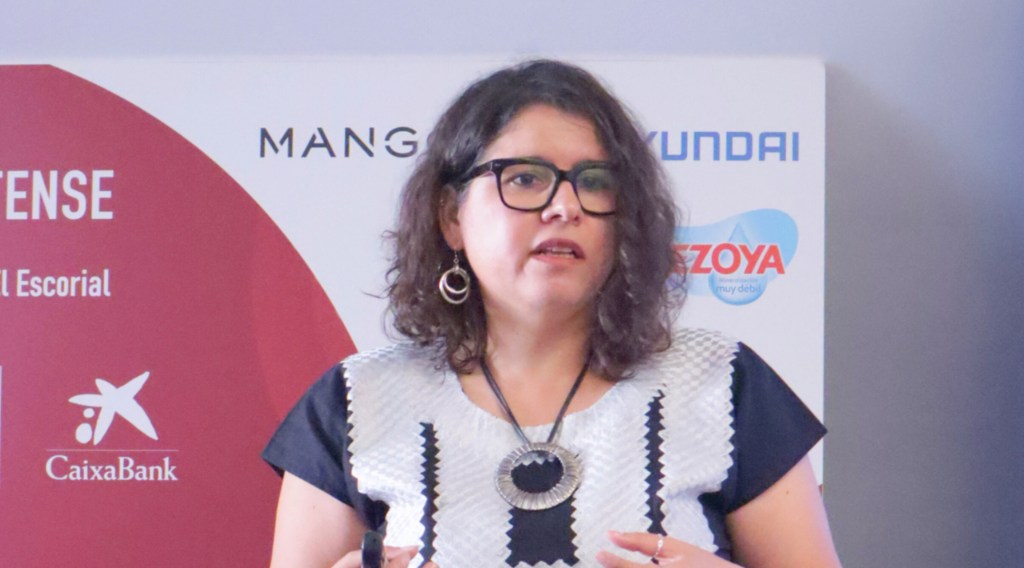
San Lorenzo del Escorial – Universidad Complutense de Madrid ●
Bajo la premisa de analizar las complejidades que enfrenta América Latina en los ámbitos social, político y de desarrollo, el curso dirigido por la también jefa de la Fundación Carolina, Érika Rodríguez Pinzón, se inauguró con una poderosa reflexión acerca de esa región del mundo: «la democracia como la entendíamos está en riesgo». Con estas palabras, Carolina Jiménez Sandoval, presidenta de la Oficina en Washington para Asuntos Latinoamericanos (WOLA, en inglés) introdujo su ponencia con relación a las perspectivas esenciales sobre los desafíos latinoamericanos. Resaltó la necesidad urgente de fortalecer las instituciones democráticas y promover la equidad social: pilares fundamentales para el desarrollo sostenible de América Latina.
«Según los datos del Barómetro de las Américas de LAPOP (siglas en inglés para Proyecto de Opinión Pública de América Latina), desde 2010 hasta 2023 disminuyó el respaldo a la democracia entre los ciudadanos latinoamericanos, pasando de 63% a 48%», aseguró Jiménez Sandoval. La experta añadió que las cifras revelaban la complejidad de la situación política regional.
A su vez, la presidenta de la WOLA enfatizó la diversidad de manifestaciones autoritarias en América Latina, recordando desde los regímenes consolidados en el pasado en Nicaragua, Venezuela y Cuba, hasta nuevas formas emergentes. Como ejemplo, propuso el caso de Nayib Bukele en El Salvador. Mencionó que esa multiplicidad política impide una clasificación simplista del panorama político actual. De igual manera, Jiménez Sandoval mencionó: «América Latina tiene menos tiempo como república del que tuvo en su periodo colonial, así que aún cuenta con mucha jerarquía de poder que influye en cómo vivimos en la región».
También, Carolina Jiménez Sandoval insistió en que se necesita distinguir los tipos de autoritarismo y las implicaciones en la región. La especialista señaló que, mientras algunos países, como Uruguay, destacan por su estabilidad democrática relativa, otros enfrentan desafíos más graves en términos de libertades civiles y derechos políticos. «El autoritarismo en el siglo XXI ha evolucionado significativamente, adaptándose a la era digital y global», señaló la especialista. «Este fenómeno se manifiesta no sólo en políticas represivas y cierres de espacios cívicos, sino también en el uso estratégico de las redes sociales y la comunicación mediática para consolidar el poder y desinformar a la ciudadanía», añadió Jiménez.
Durante la ponencia, Jiménez Sandoval destacó cómo los regímenes autoritarios suelen ser patriarcales y anti-derechos, erosionando sistemáticamente las libertades individuales y colectivas en nombre de la estabilidad política y el control del poder. La especialista mencionó que «no podemos dar por sentada la democracia ni subestimar las amenazas que enfrenta en nuestros días», sugiriendo la urgencia de comprender mejor las dinámicas políticas de la región y de fortalecer las instituciones democráticas. ✦
«Latin America is a complex landscape affected by the rise of authoritarianism», insisted Carolina Jiménez Sandoval
San Lorenzo del Escorial – Universidad Complutense de Madrid ●
Under the premise of analyzing the complexities Latin America faces in the social, political, and development areas, the course directed by the chief of Fundación Carolina, Érika Rodríguez Pinzón, was inaugurated with a strong reflection on this region of the world: «democracy as we know it is at risk». With these words, Carolina Jiménez Sandoval, President of the Washington Office on Latin America, introduced her presentation about the essential perspectives around the challenges that point of the world faces. She pointed out the urgent need to strengthen democratic institutions to promote social equality: fundamental pillars for the sustainable development of Latin America.
«According to the information in LAPOP’s (Latin American Public Opinion Project) Barometer of the Americas, from 2010 to 2023 democracy’s backup diminished among Latin American citizens, going from 63% to 48%», insisted Jiménez Sandoval. The expert added that these numbers reveal that the region’s political situation is complex.
At the same time, the President of WOLA emphasized the diversity found in authoritarian manifestations in Latin America, bringing back the regimes consolidated in the past in Nicaragua, Venezuela, and Cuba and mentioning the emergent forms. For example, she proposed the case of Nayib Bukele in El Salvador. Jiménez Sandoval mentioned that such political diversity does not allow a simple classification of today’s political panorama. Jiménez also said: «Latin America has been a republic a shorter time than a colony, so a clear hierarchy within the powerful still exists and affects how we live in the region».
Also, Carolina Jiménez Sandoval insisted on the need to distinguish the different types of authoritarianism and their implications in the region. The specialist pointed out that, while some countries like Uruguay are distinguished for their democratic relative stability, others face gravier challenges regarding rights and liberties. «The authoritarianism in the 21st century has evolved meaningfully, adapting itself to the digital and global era≫, underlined Jiménez. ≪This phenomenon is evident not only in the repressive political actions and the closure of civic spaces, but also in the strategical use of social media and other platforms that consolidate power and disinform the citizens», she added.
During the presentation, Jiménez Sandoval distinguished how the authoritarian regimens tend to be patriarchal and against rights, systematically eroding both individual and collective liberties in the name of political stability and power control. The specialist mentioned that «we cannot take for granted democracy or underestimate the threats it faces nowadays», suggesting the urgency of a better understanding of political dynamics in the region and of strengthening the democratic institutions. ✦

 El dossier de Lourdes
Deja un comentario