
Inspirados por la próxima inauguración de la ópera Patagonia – escrita por Rodrigo Ossandón y musicalizada por Sebastián Errázuriz, especialistas dialogan por iniciativa de ‘Kanika’ sobre la situación actual y el futuro de la lengua que comparten más de 500 millones de personas en el mundo.
21 de febrero de 2025 – Madrid, España ●
Con el paso de los siglos, el idioma español ha demostrado no sólo haberse convertido en el eje de la identidad de muchos, sino estar vivo y en constante movimiento. Tal y como menciona Antonio Machado en sus versos, la palabra es viajera y – por definición – se adapta a las circunstancias de tiempo, espacio y personalidad de quienes la pronuncian.
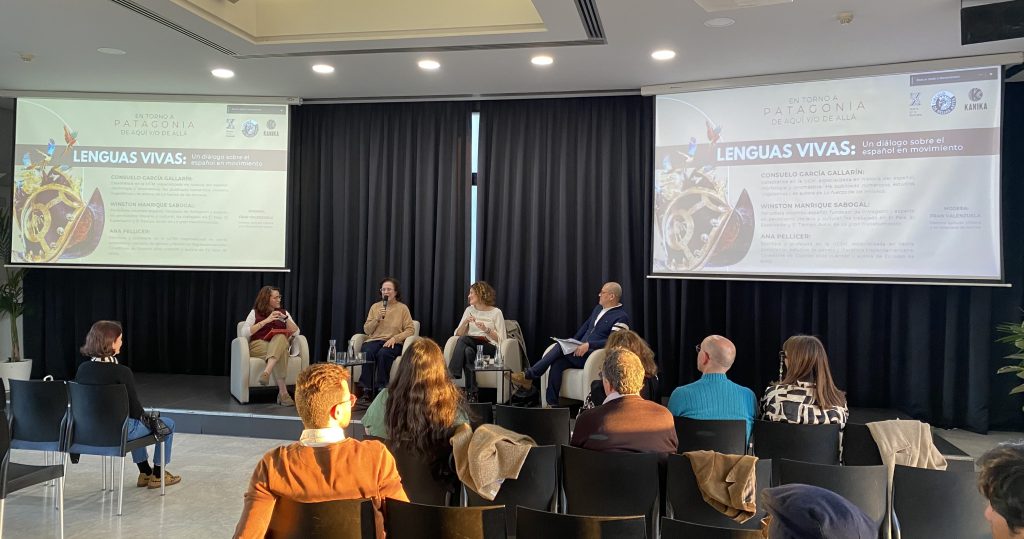
El Círculo de Bellas Artes de Madrid fue el escenario de la mesa redonda Lenguas vivas: Un diálogo sobre el español en movimiento. Ésta fue convocada por la gestora cultural latinoamericana ‘Kanika‘ y estuvo conformada por la catedrática Consuelo García Gallarín, la escritora y profesora Ana Pellicer y el periodista Winston Manrique Sabogal. El diálogo consistió en reflexionar sobre los lenguajes verbal y no verbal, de forma que quedase claro el poder de la comunicación en la sociedad humana. Moderados por Fran Valenzuela, la conversación tocó temas como la historia, la música y la posible existencia de un lenguaje globalizado y heterogéneo.
Por un lado, Consuelo García Gallarín aseguró que «no hay manera de que se consolide una versión unificada del español, pues es pluricéntrico y plurinormativo». Desde esta perspectiva, insistió en que la visión europeísta está superada y que un idioma responde a las necesidades comunicativas de cada territorio. «Dependiendo del caso existen diversos desarrollos semánticos», señaló García Gallarín. La base ‘pan-hispánica’ es lo que mantiene unidos a los hablantes, quienes habrían de procurar respetar las variedades de su idioma «introduciéndose en ese océano», puntualizó la catedrática.
Por otro lado, en contraste con la idea de unión que pudiese fomentar el dominio de un mismo idioma, Winston Manrique Sabogal se apresuró a mencionar que América Latina es un archipiélago. Se trata de diecinueve islas que no están en comunicación a pesar de su historia en común, uniéndose casi exclusivamente gracias al ciberespacio. El periodista aseguró que el español fue elegido como lengua principal fuera de la península por pragmatismo, haciendo a un lado los idiomas de origen.
Afortunadamente, en tiempos recientes estos últimos han sido polinizados a través de la música y la literatura. Incluso, mencionó que «los jóvenes están creando una gran lengua con modismos que provienen de todas partes. Se trata de un lenguaje con una riqueza única».
Además, Ana Pellicer se refirió específicamente a la lengua originaria que la obra de Ossandón menciona entre sus líneas: el tehuelche. Hablada por los indígenas sudamericanos de la Patagonia, es evidente que ésta sigue viva por casos de empatía como fue el del guionista chileno. «El rescate de lenguas como ésta es una de las ventajas que ofrecen las tecnologías actuales”, añadió Pellicer. Igualmente, la profesora distinguió la relevancia del papel de la mujer en la obra. La trama presenta el punto de vista de la mujer indígena liberada del estereotipo europeo para los grupos originarios.
Dentro de los múltiples lenguajes mencionados en el evento, la música fue señalada por los participantes como uno elemental por sus rasgos de universalidad. «La música nos interpela a todos, volviéndose uno de los espacios de encuentro para los iberoamericanos», estableció Ana Pellicer. Consuelo García Gallarín añadió al respecto que su experiencia personal con ciertas piezas musicales la han motivado a fomentar la empatía y a dignificar las manifestaciones culturales como elementos clave para la evolución humana.
Finalmente, ante la pregunta del público sobre qué estrategia tomar ante el dominio de la lengua anglosajona, Winston Manrique Sabogal mencionó que «el poder del inglés en términos científicos, de la información y tecnológicos es claro, pero el español puede usar la cultura, la música y la traducción [para mantenerse presente]».
El español se transforma junto con las identidades complejas de quienes lo hablan. Tal y como se dijo en esta mesa redonda, nos encontramos en un espacio convulso en donde hemos de hacer activismo a favor del idioma. Sin importar el país al que pertenezcan o la edad que posean, el futuro de esta lengua y la unión de quienes la hacen suya parecieran estar condicionados a que se conozcan sus variantes y se beba de esa abundancia. ✦
Can Spanish Bring Its Speakers Together?
Inspired by the upcoming premiere of Patagonia – opera written by Rodrigo Ossandón and musicalized by Sebastián Errázuriz, specialists discuss by initiative of ‘Kanika’ of the current situation and future of the language shared by 500 million people around the world.
February 21st, 2025 – Madrid, Spain ●
Over the centuries, Spanish has proven not only to have turned into the identity axis for many, but to be alive and in constant movement. Just as Antonio Machado expresses in his verses, the word is traveler and – by definition – it adapts to the circumstances of time, space, and personality of those who speak it.
The Circle of Fine Arts in Madrid was the scenery to the Living Tongues: A Dialogue About Spanish In Movement roundtable. The latter was convened by the cultural management enterprise ‘Kanika‘ and was composed by professor Consuelo García Gallarín, writer and teacher Ana Pellicer, and journalist Winston Manrique Sabogal. The conversation consisted of reflecting on verbal and non-verbal languages, clarifying the dimension possessed by communication within human society. Moderated by Fran Valenzuela, the conversation touched on topics such as History, music, and the possibility of a unique, globalized, and heterogenous language in the modern world.
On one hand, Consuelo García Gallarín assured that «there is no possible way to consolidate a unified version of Spanish, since it is pluricentric and pluri-normative». From this point of view, she insisted that the European vision is now behind and that a language must answer to the communication needs that appear in each territory. «Depending on the case, there are diverse semantic developments», García Gallarín pointed out. The ‘pan-Hispanic’ base is what brings the speakers together, who must procure to respect the differences within their language «introducing themselves in those waters», pointed out the professor.
On the other hand, in contrast with the idea of union that could foment the dominion of the same language, Winston Manrique Sabogal mentioned that Latin America is an archipelago. Nineteen islands exist without real communication among themselves notwithstanding their common past, relating almost exclusively thanks to the cyberspace. The journalist made clear that Spanish was chosen as the main tongue outside of Europe due to mere pragmatism, putting the local tongues aside.
Fortunately, in recent times these last languages have been polinized through music and Literature. Plus, he mentioned that «youngsters are creating a big language with modisms that come from everywhere. A language with a unique richness is being brought to life».
Plus, Ana Pellicer referred specifically to the originary tongue that appears in the play written by Ossandón: tehuelche. Spoken by the Southamerican indigenous people, it is evident that it is still alive due to empathy cases such as the one of the Chilean scriptwriter. «The rescue of languages such as this is one of the advantages modern technologies have», added Pellicer. In the same way, the professor distinguished how the role of women receives importance in the plot. The story presents the point of view of an indigenous female liberated from the European stereotype for originary groups.
Among the various languages alluded to in the event, music was mentioned by the participants as one of the most important due its traits of universality. «Music interpoles us all, turning into one of the encounter points for Iberamericans», established Ana Pellicer. Consuelo García Gallarín added that, in her personal experience, certain songs have motivated her to gain empathy and dignify the cultural manifestations as key elements to human evolution.
Finally, to the question from the audience about what strategy to choose before the dominion English language has, Winston Manrique Sabogal mentioned that «the power of English in science, information, and technology is clear; however, Spanish can thrive in culture, music, and translation [to stay in scene]».
Spanish transforms along with the complex identities of those who speak it. Just like it was said in this roundtable, we are living in a convulse entourage where we should do activism in favor of the tongue. No matter the country they belong to or the age they have, the future of this language and the union of those who make it their own is conditioned to knowing all about its variations and drinking of that water of abundance. ✦

 El dossier de Lourdes
Deja un comentario